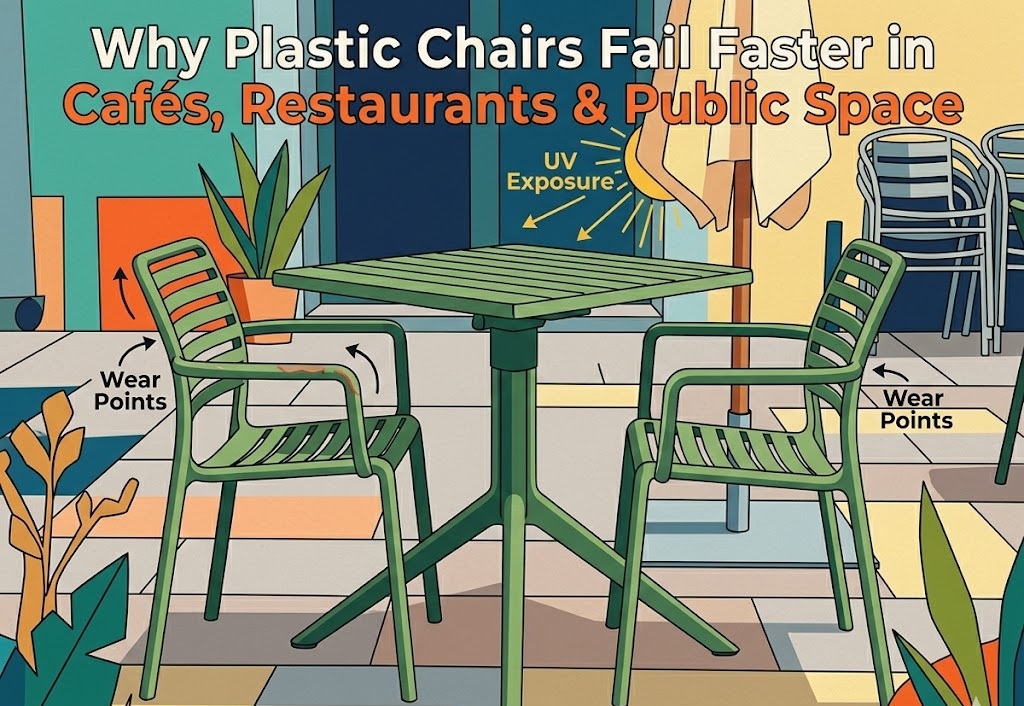
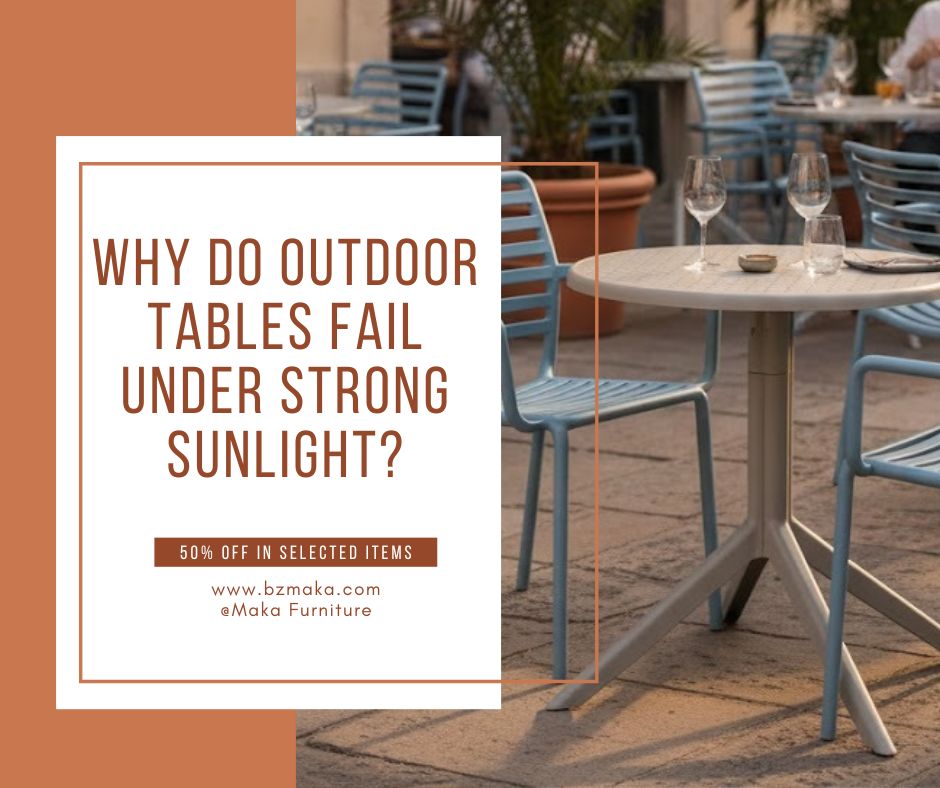
Outdoor tables often look perfect when newly installed.
But after one summer season, many hospitality operators begin noticing problems:
For distributors and project buyers, this creates a serious question:
Why do outdoor tables deform even when they are labeled “UV resistant”?
The answer lies deeper than UV protection alone.
Outdoor deformation is primarily an engineering and material behavior issue.
Direct sunlight does more than expose furniture to UV rays.
In real outdoor environments — especially in Europe, Australia, and the Middle East — tabletop surface temperatures can reach:
60°C – 75°C (140°F – 167°F)
At these temperatures, plastic materials begin to behave differently.
Even high-quality polymers slightly soften under heat.
If structural design is insufficient, gradual deformation begins.
This process is slow and often unnoticed at first.
But once deformation starts, it rarely reverses.
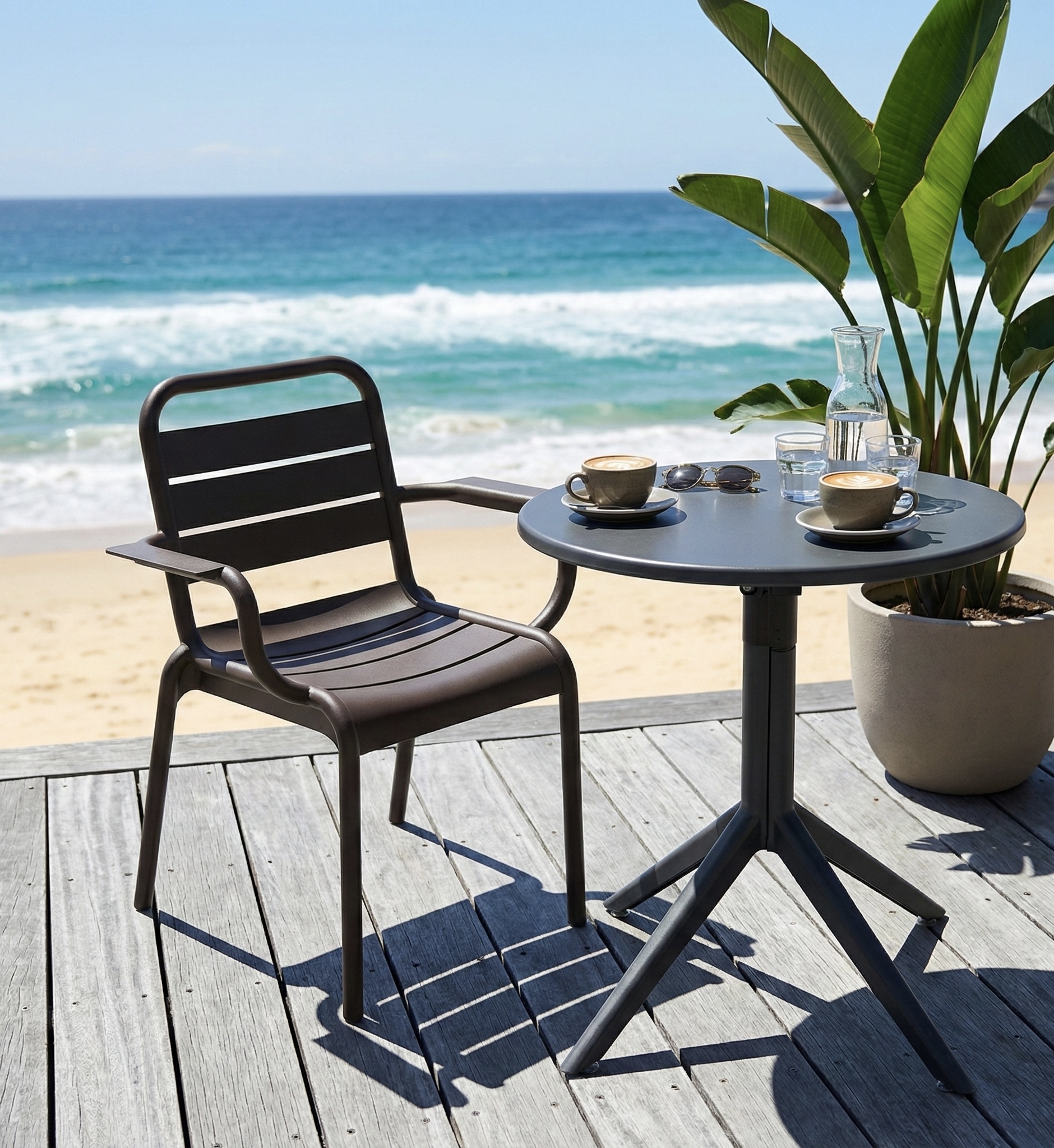
Outdoor table deformation usually results from three combined forces:
Sunlight heats the tabletop unevenly.
The upper surface expands faster than the internal structure, creating internal stress.
Restaurants and cafés place continuous loads on tables:
Under softened conditions, materials slowly creep downward.
During the day:
material expands.
At night:
material contracts.
This repeated thermal cycling gradually weakens structural resistance.
Over months, permanent shape change occurs.
This phenomenon is known in engineering as thermal creep deformation.
A common industry issue is testing mismatch.
Many tables successfully pass:
However, laboratory tests often do not simulate:
As a result, products appear compliant but fail in real hospitality environments.
Two tables may look identical but perform completely differently outdoors.
Key engineering differences include:
Proper rib structure distributes stress across the tabletop.
Poor reinforcement allows localized bending.
Low-density materials deform faster under heat.
Commercial-grade formulations maintain stiffness longer.
Uniform thickness prevents stress concentration zones.
Thin central areas are common failure points.
Professional outdoor tables are engineered considering high-temperature behavior, not room-temperature performance.
Leading distributors increasingly ask deeper technical questions:
| Buyer Concern | Real Operational Risk |
|---|---|
| Will tables stay flat after summer? | Customer complaints |
| Can structure resist heat creep? | Replacement cost |
| Is outdoor testing realistic? | Brand reputation |
| Is design commercial-grade? | Project reliability |
Outdoor furniture purchasing today is less about specification sheets and more about predictable long-term performance.
This distinction explains many sourcing failures.
Residential outdoor tables
Commercial outdoor tables
Products designed for home patios often deform quickly in restaurants or public terraces.
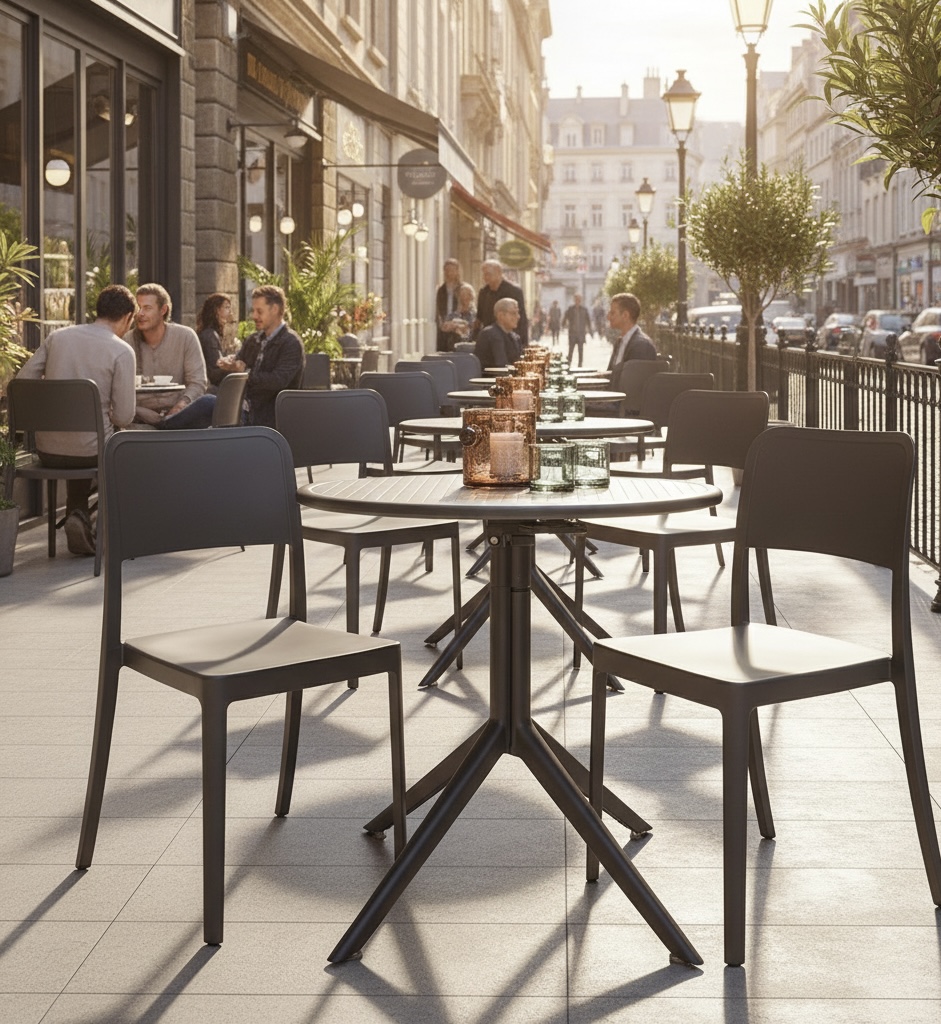
To prevent deformation under sunlight, outdoor tables should incorporate:
✅ Heat-resistant structural geometry
✅ UV stabilization integrated into material formulation
✅ Reinforced load distribution design
✅ Aging simulation testing combining heat + load + time
✅ Fatigue-oriented commercial engineering
Because outdoor durability depends on years of stability, not initial appearance.
For importers and distributors, deformation creates consequences beyond product replacement:
In hospitality projects, stability equals trust.
Outdoor tables rarely deform suddenly.
They deform because heat behavior was never considered during design.
When evaluating outdoor tables exposed to strong sunlight, professional buyers should ask:
✔ How does the table perform at high temperatures?
✔ Has thermal aging been considered?
✔ Is the structure designed for commercial exposure?
Because in commercial outdoor furniture:
Durability is engineered — not claimed.
Fill out the contact form with your ideas today and find the right furniture sets for your room applications.

MAKA offers high-performance and personalized furniture for any room and condition at affordable prices. Order now at an MOQ of 100.